
How confident are you in your current sales coverage?
How much do you trust your marketing engine to create the right level of engagement with the right targets?
How many of your first meetings turn into real opportunities?
How much time can your revenue team spend fixing it without hurting this quarter?
Commercial efficiency. Two words most companies split across two teams, two budgets, two tools and two scorecards.
They should never have been split. In B2B tech, it is ALL about sales. Marketing exists to help sell. Every campaign, every webinar, every page of the website has one job: put the right buyer in front of the right offer, at the right time. Anything else is decoration.
I started at Microsoft France on the phone, knowing nothing. Since then I have been the seller, the sales manager, the partner guy, and the CRO with marketing reporting to me. I have watched the split from both sides.
The seller says the leads are junk. The marketer says the seller never calls them. Two parents arguing about the same child, in front of the child. The child is the buyer, and the buyer is already looking for the exit.
Both have a point, and both miss it. Forrester’s 2026 survey of nearly 18,000 business buyers counts 13 internal stakeholders and nine external participants in a typical decision. Twenty-two people. One lead.
When it worked for me, it came down to three agreements.
The status quo
Look at how we set them up.
I have a marketer, paid on MQLs, living in the marketing automation tool.
I have a seller, paid on closed revenue, living in the CRM.
I have a product team shipping a roadmap neither of them was asked about, and a CEO reading three dashboards that never match.
Two teams doing one job, set up by design to disagree. And no offsite, no shared Slack channel, no “smarketing” slide will unify them. Unification is not where you start. It is what you get when three things are agreed: how ready the engine really is, what the waste is, and which buyer engagement is the sole focus.
1. Measure readiness and inefficiencies
You can’t agree on what you can’t see. Every company can tell you its pipeline coverage. Very few can tell you how ready their commercial engine is to win the buyers they say they want.
So score it, like a credit score. One number everyone reads the same way, from the CEO to the newest seller. Three readings of the same engine: what the company says it delivers, what it actually delivers in closed-won, closed-lost and time to close, and what good looks like in its market. The waste lives in the gaps between the three.
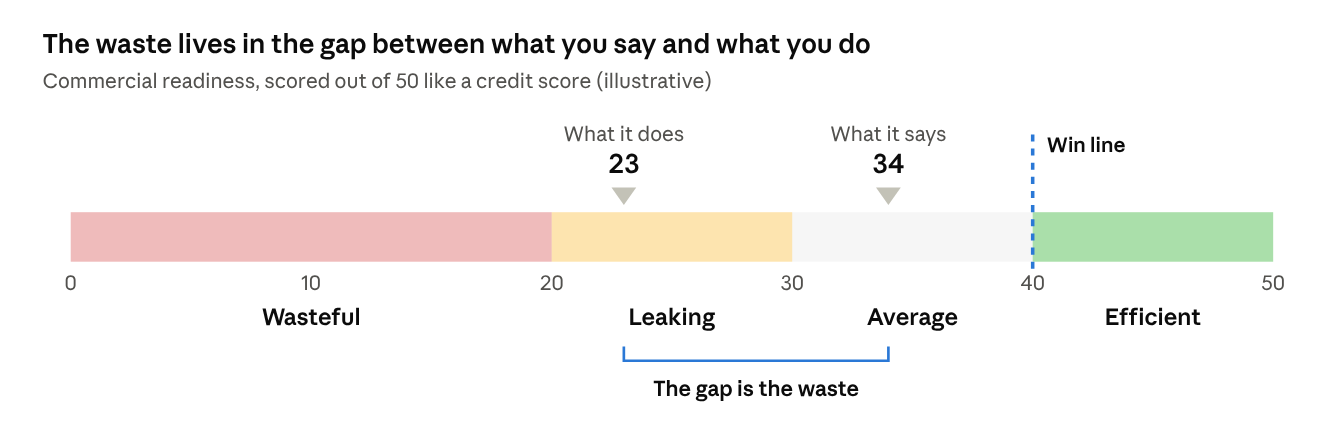
commercial readiness score · illustrative
Marketing is moving in that direction, to be fair. Demand Gen Report’s 2026 benchmark, published this week, says MQL counts aren’t the headline anymore: pipeline influenced is now the top metric marketers are measured on. Progress. Though “influenced” remains a generous word.
2. Address the waste, in its full definition
Waste nobody agrees on is just an opinion in a QBR. And most companies define it far too narrowly: a bad lead, a wasted campaign. The full definition is wider. Wrong accounts, wrong buyers, wrong offers, wrong deals, slow cycles, closed-lost nobody learns from, leads that mean nothing, activity counted at the wrong level. Named and agreed, each one becomes a fix. Take a data platform company selling to banks, my kind of market. The waste hides in four places.
Target. The ICP slide was written for the last fundraise. The client base drifted, stretched to fit the quarter: a buyer too junior, a segment too small. Meanwhile, the real buying group grew. Per Forrester, when genAI features are involved it doubles, from seven to 14 people, and in G2’s 2026 survey finance involvement jumped from 31% to 46% in a single year. Three thousand engineers who downloaded the guide don’t make a buying group. The fix: one list, built by seller and marketer together, around the people who sign.
Offer. Open the truck. Features oversold that sellers learned to dance around, and the real strength buried on page 14 of the website. Now add a fourth storyteller: 82% of buyers in that same G2 survey sourced software recommendations from an AI chatbot. If your website, your deck and your seller disagree, the machine will happily pick one for you. The fix: one no-brainer offer, built on the real strength, told the same way everywhere.
Engagement. Six hundred badges scanned, two meetings three weeks later, and a sore back from the booth. The fix: next section.
Measure. Activity counted as results, at every level of the company. The fix: the score above, tracked by everyone, including the client.
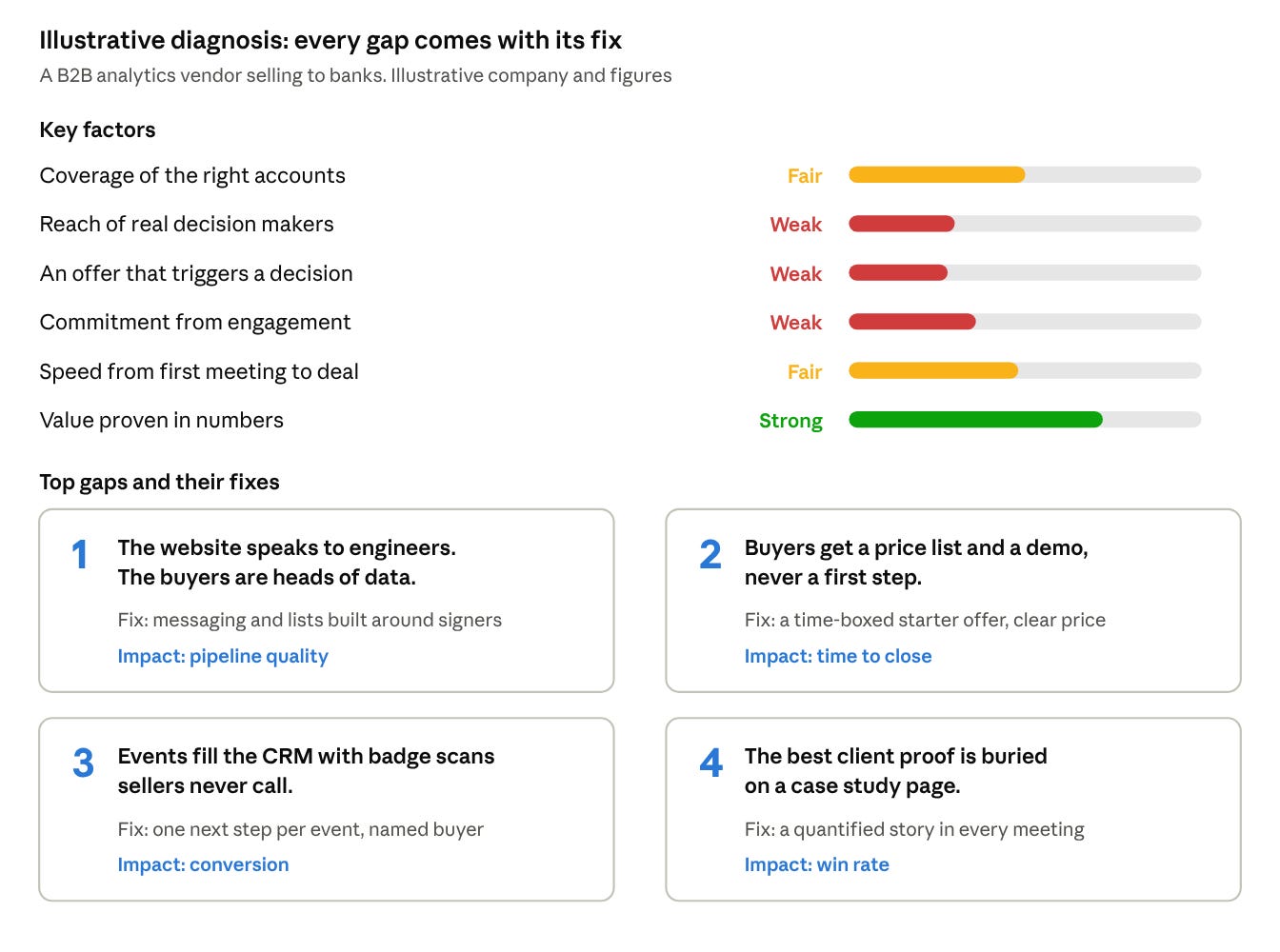
illustrative diagnosis · key factors and top gaps
This is what agreeing on the waste looks like on one page. Every gap is named, and every gap comes with its fix and the number it moves.
3. Agree on the engagement that matters
This is the agreement that ends the leads debate. Everyone, CEO and client included, agrees on the level of buyer engagement that is the sole focus. Below that line, nothing counts as a result. And yes, it goes into the comp plans. An agreement nobody is paid on lasts exactly one quarter.
A download is not bad. A webinar seat is not bad. A badge scan, a like, an intent signal: activity, neutral at best, sometimes useful. Engagement is a commitment that heads straight into a sales transaction. A meeting with a decider. A workshop on the buyer’s problem. A proof with success criteria written down. Above the line, you celebrate. Below it, you learn.
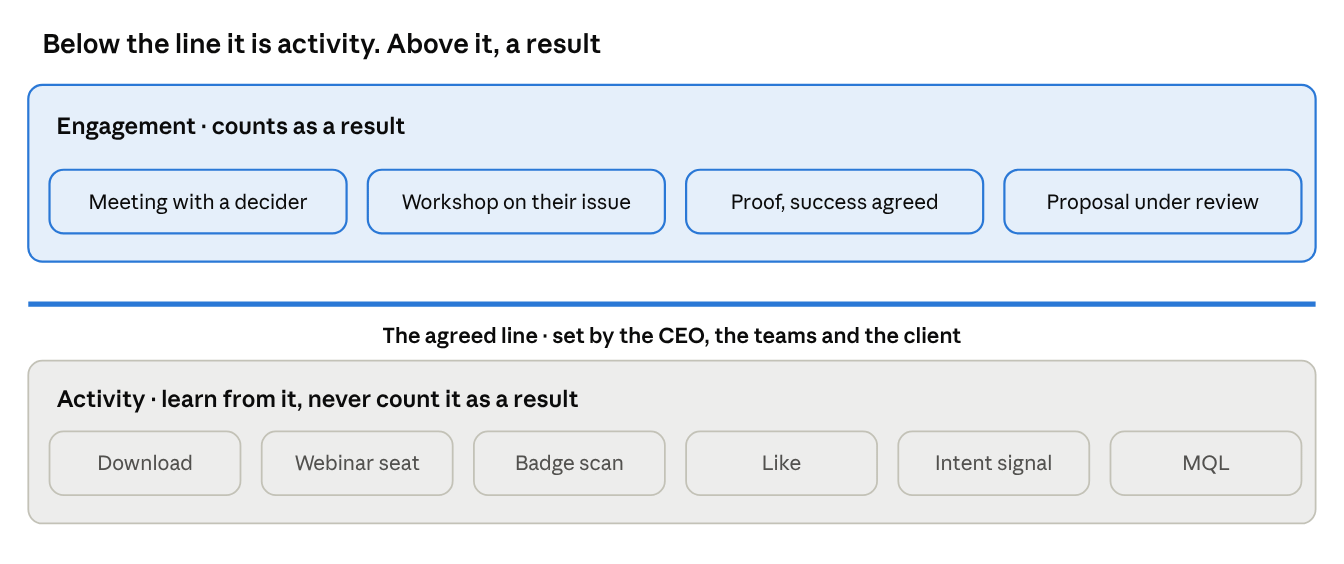
the engagement line
Buyers drew that line long before we did. In Gartner’s 2026 survey of 646 buyers, 67% prefer a rep-free experience. Yet 69% still turn to a sales rep to validate what AI told them. They will give you very few moments. Each one had better sit above the line.
By design
Measure readiness. Address the waste. Agree on the engagement that matters. Do those three, and the seller, the marketer, product and the CEO end up unified without anyone asking them to be. None of it requires a new tool. All of it requires the CEO to own the agreement, and the client to sign it too.
The leads debate never dies completely. Someone will always ask for the MQL count in the board deck. But it stops running the company.
That is how I have made it work so far. If you have made it work differently, I want to hear it.
Sources
Forrester, The State Of Business Buying, 2026 (Buyers’ Journey Survey, nearly 18,000 global business buyers), January 2026
Gartner, Gartner Sales Survey Finds 67% of B2B Buyers Prefer a Rep-Free Experience (646 B2B buyers), March 9, 2026
Gartner, Gartner Survey Finds 69% of B2B Buyers Turn to Sales Reps to Validate AI-Generated Insights (645 B2B buyers), May 20, 2026
G2, 2026 Buyer Behavior Report (1,000+ B2B software buyers), July 22, 2026
Demand Gen Report, 2026 B2BMX Insights Benchmark Survey Results, October 14, 2026