
Sales and marketing are two sides of the same coin. Somewhere along the way, we started spending them as two currencies.
I have led both, side by side and under one roof. The most expensive thing I saw in either function was the line drawn between them.
My last article proposed three agreements to end the leads debate. This one goes upstream: why the two functions grew apart in the first place, and why, in B2B tech, the split costs more every year.
Two owners, one buyer
For decades, we said one group builds pipeline and another forecasts and closes. Marketing got the top of the funnel, sales got the bottom, and the handoff got a name: the MQL. Two scorecards, two toolsets, one buyer.
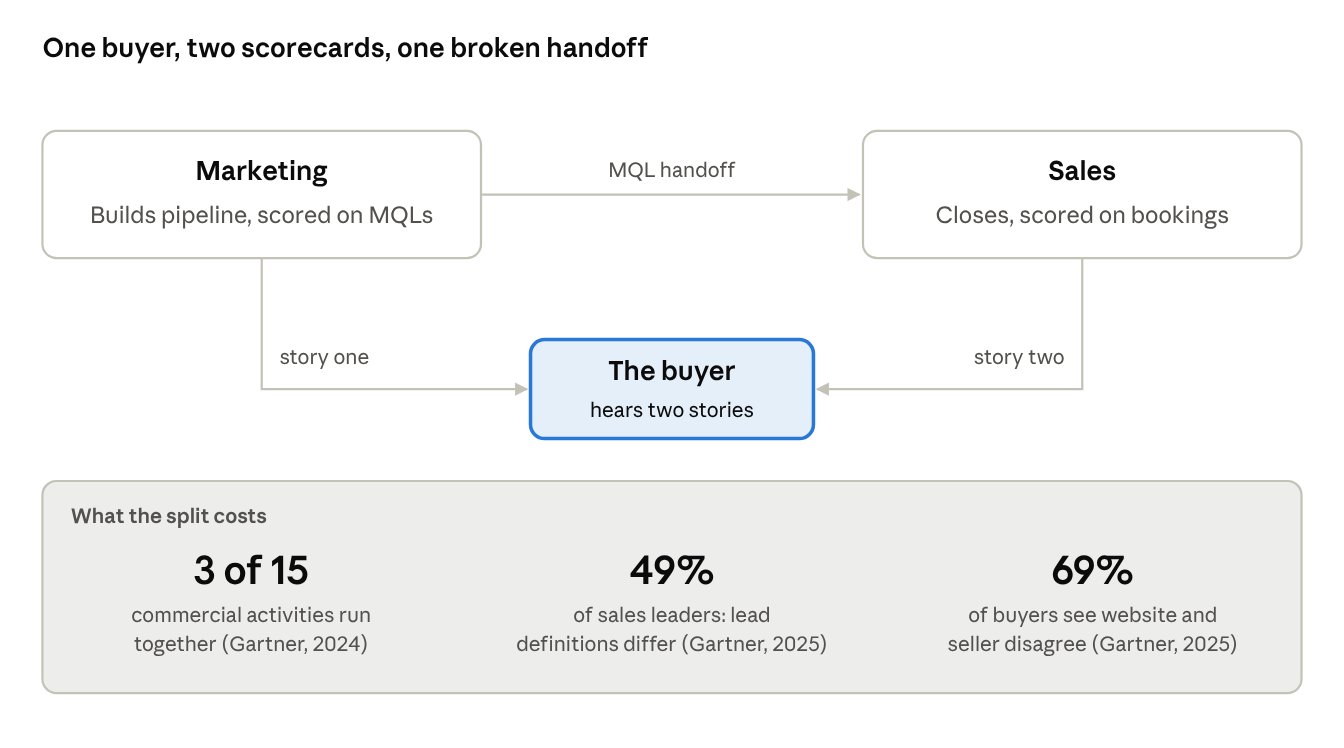
The studies show what that line costs. Sales and marketing run only 3 of 15 commercial activities together, and 90% of their leaders say their priorities conflict (Gartner, June 2024). 49% of sales leaders say the two define a qualified lead very differently (Gartner, May 2025). And 69% of buyers notice that the website and the seller tell different stories (Gartner, June 2025).
Two parents, one child, and the child is listening.
One expectation
For most B2B tech companies today, let’s say it: the only expectation is to create new opportunities. Sellers want hot engagements. The CRO wants predictable revenue and low churn. The board wants both on a flat budget: 7.7% of revenue, with 59% of CMOs saying it is not enough (Gartner, May 2025).
So every marketing discipline gets one test: does it create a qualified engagement? Here is how each one changes, illustrated with a cloud cost-management vendor.
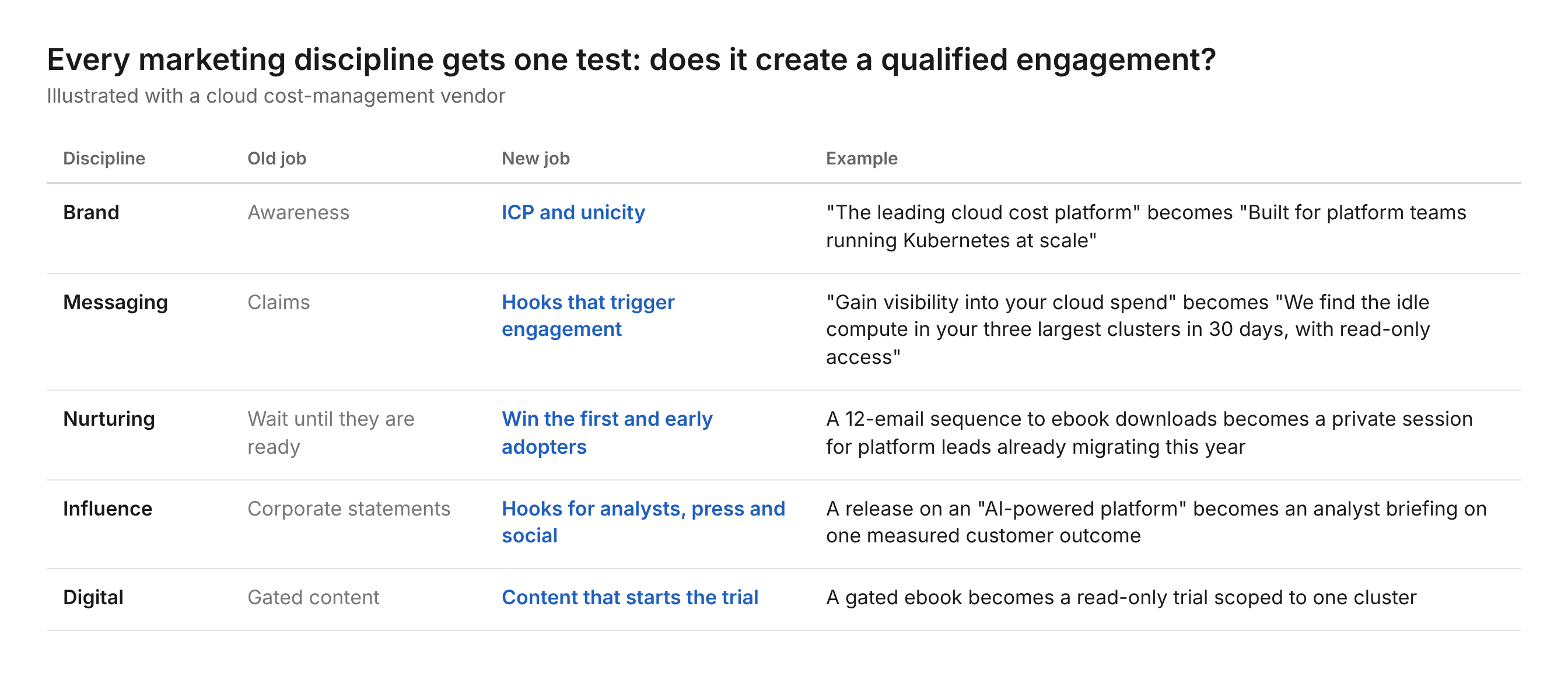
Brand is a consumer concept that hardly exists in enterprise tech. In the 2025 Edelman-LinkedIn study of nearly 2,000 decision makers, 53% said strong thought leadership makes brand recognition matter less. 85% named a demonstrated understanding of their business challenges as a top factor in the final decision (Demand Gen Report, July 2025).
Nurturing is a polite way to say we will wait until you are ready to buy. No buyer is getting nurtured by a vendor anymore. In 6sense’s 2025 study of nearly 4,000 buyers, four of five shortlist spots were set on day one, and buyers bought from their top-ranked vendor 77% of the time (CustomerThink on 6sense). On qualified demand, own the first adopters and the early adopters and you lead the demand. On a new trend, the first adopters are all that matter.
Hooks carry everything else. 73% of buyers avoid suppliers whose outreach feels irrelevant, and 61% would rather buy with no rep at all (Gartner, June 2025). 94% use AI in their buying process, then check it with peers, experts and analysts, and more than 60% evaluate through a trial (Forrester, 2026). Boilerplate feeds none of that.
The sales side is marketing
Now turn the coin over. Qualifying a territory is absolutely a marketing exercise, if not THE definition of marketing: ICP criteria applied to real market demand.
Take our cloud cost vendor. It raised its last round on a TAM of 12,000 accounts and split them across six sellers: 2,000 each. No seller can work 2,000 accounts, so each one picks by instinct, logo or last quarter’s luck.
Now trim. The ICP first: platform teams running Kubernetes at scale, with a cloud bill big enough to matter. 2,000 accounts left. Then demand this cycle: a public migration, FinOps hiring, cost cuts announced to investors. 300 left. Then reach: a named buying group and a hook that lands. 90 accounts, 15 per seller, each worth a real week.
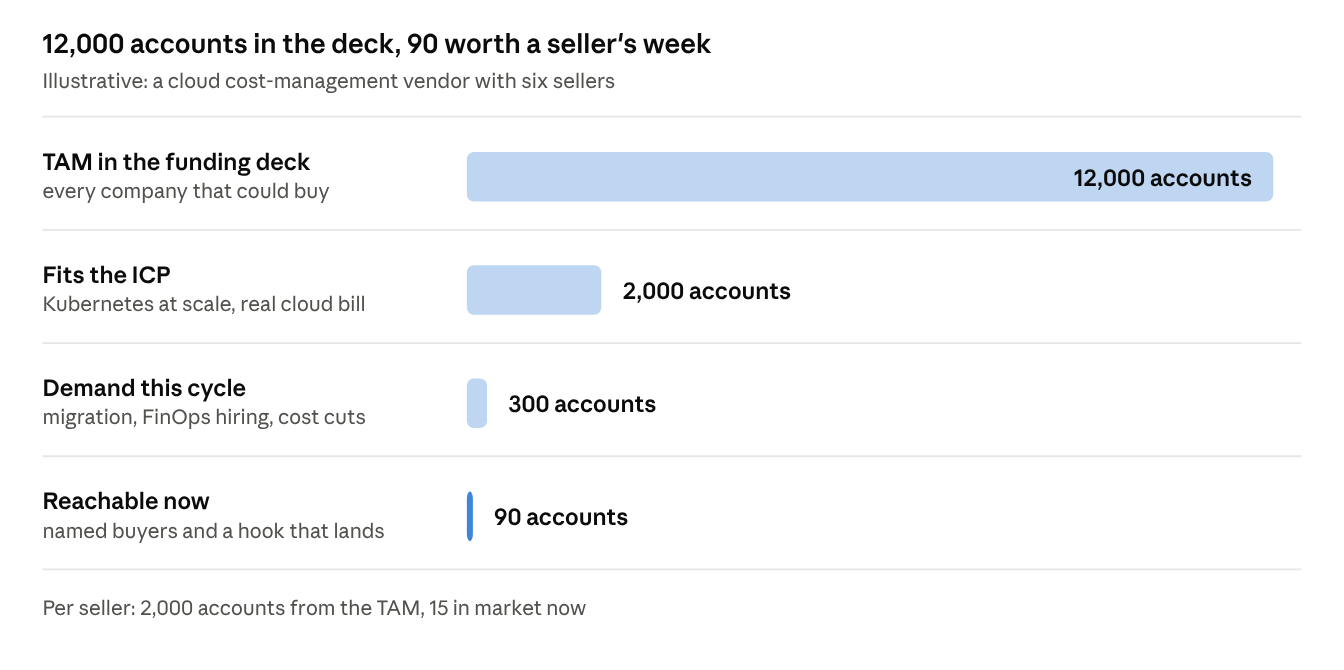
Sellers, marketers and product managers should run that trim together, or each on their own and land on the same 90. The seller sees where to spend the week. The marketer sees who to invite to a private session. The product manager sees which demand is real this cycle.
Searching and engaging buyers is the same exercise one level down. How is that not the epitome of applied marketing messaging, still on ICP, unicity and persona?
The sales cycle is probably the one motion unique to sales. But every cycle, won or lost, is marketing intelligence. A lost deal gets tagged “price” in the CRM. The buyer interview says the CFO could not see the saving before signing. Marketing fixes the proof, product adds a savings report to the trial, sales leads with it.
Few companies close that loop. Only 39% run an ongoing, cross-functional win-loss program (Clozd, 2025), and on average 40% of deals get analyzed at all (Klue, 2025). Teams that share buyer insights are 2.3 times more likely to see higher conversion and 1.6 times more likely to beat revenue growth expectations (Gartner, June 2024).
The missing third
Drawing marketing and sales as distinct swim lanes is a huge mistake, and it creates the majority of commercial waste. The second mistake sits next to it: keeping product management (not engineering) out of commercial.
Product management is understanding a market demand, defining how to capture it and beat the competition, then building adoption until the product is pervasive. How is that not a pillar of the commercial function?
Buyers test that pillar directly. More than 60% buy some form of trial, and just over a third plan to convert to a fully paid version with the same provider (Forrester, 2026). Back to our cloud cost vendor: its trial shows beautiful dashboards, and the buyer leaves without a saving to show the CFO. Marketing blames the trial, sales blames the lead, product blames the buyer. One question would have fixed it: what must the buyer prove in week one?
But give three distinct people an officer role, one for marketing, one for revenue, one for product, and you create three swim lanes, each with a budget, a dashboard and a story for the board. The top is starting to question it: only 36% of Fortune 500 companies still use the title Chief Marketing Officer, down from 49% a year earlier, as growth, commercial and customer officer titles take its place (Forrester).
Build, promote, sell
Is there a simple organizational answer to commercial waste? No, of course. You need checks and balances. But commerce is a complex and comprehensive function: the act to build, the act to promote and the act to sell have to work as one.
Buyers already pay for their own version of the split: more than 40% of B2B deals stall because of misalignment inside the buying group (Demand Gen Report, July 2025). A vendor that shows up with three stories adds to the confusion.
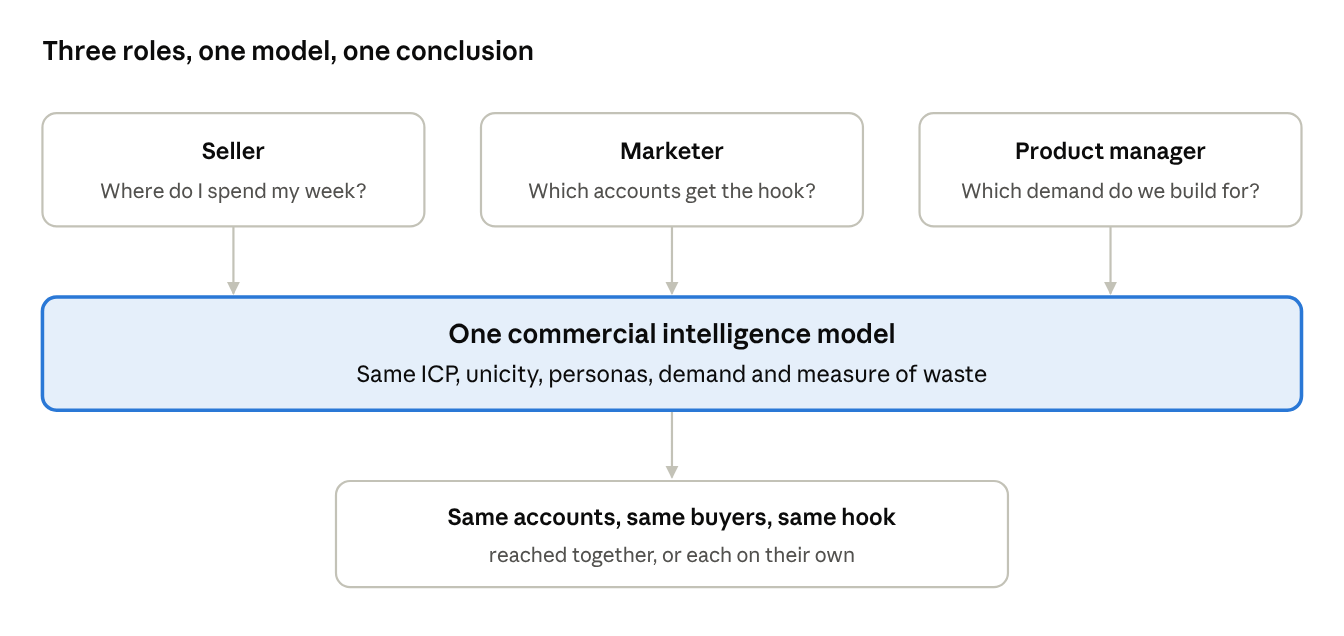
That is why I built my method on the full spectrum: one commercial intelligence model for sellers, marketers and product managers. Each starts from their own question. All three work from the same ICP, unicity, personas, demand and measure of waste, so they reach the same conclusion.
The leads debate never dies completely. Two sides of the same coin will always argue a little. If you have built it differently, or think product belongs somewhere else, I want to hear it.
If your build, promote and sell teams are still running three races, let’s compare notes. Book 30 minutes with me, or see how I work at https://www.atoutnow.com
The stat about 69% of buyers noticing the website and the sales conversation don't match is the one I'd put in front of both teams. The buyer experiences one company and hears two stories.